
Role of Biomedical Engineering Department and Medical Gas plant during different phases of the Disaster Management
Article Type: Short Communication
Year: 2025; Volume: 5; Issue: 4; Page No: 8 – 12
Author: Shalini Shribalaji
Affiliation: General and Geriatric Physician, Mahatma Gandhi Medical College and Research Institute (Sri Balaji Vidhyapeeth University, Pillayarkuppam, Pondicherry-Cuddalore Main Road, Pondicherry, Puducherry (UT), India.
Email ID: shalinikaliaperumal@gmail.com
 https://doi.org/10.55349/ijmsnr.202554812
| How to cite this article: Shribalaji S. Role of Biomedical Engineering Department and Medical Gas Plant during different phases of the Disaster Management. Int J Med Sci and Nurs Res 2025;5(4):8–12. DOI: https://doi.org/10.55349/ijmsnr.202554812 |
Corresponding Author:
Dr. Shalini Shribalaji,
No. 64A, Sivgami Nagar,
Reddiyarpalayam,
Pondicherry,
Puducherry (UT), India.
Email ID: shalinikaliaperumal@gmail.com
ORCID: https://orcid.org/0000-0002-4084-9514
Article Summary: Submitted: 12-October-2025 Revised: 28-October-2025 Accepted: 19-November-2025 Published: 31-December-2025
Abstract
Background: Disaster as per the American College of Emergency Physicians is “when the destructive effects of natural or man-made forces overwhelm the ability of a given area or community to meet the demand for health care”. In this article, I have discussed about the role of biomedical engineers, Gas plant technician role in a hospital, Brief explanation of Disaster and its consequences, Precautionary steps to be taken by BME and gas plant for disaster, during disaster, post disaster and challenges expected during the disaster.
Methods: In this, the role of biomedical engineers or Clinical Engineers, Gas plant technician role in a hospital, Brief explanation of Disaster and its consequences, Precautionary steps to be taken by BME and gas plant for disaster, during disaster, post disaster and challenges expected during the disaster, and wrote the summary of this.
Results: Biomedical Engineers role starts from procurement, maintenance, safety and till decommissioning of medical equipment and their interaction. The technicians associated to this plant involve in the management of the above gases where they help in storage, handling, distribution of medical gas cylinders. When the news regarding the situation has been informed, minimum two engineers are to be deputed to collect data of the unutilized critical care equipment which are not being connected to the patient in ICUs. Arrangements for shifting of this equipment are to be started immediately.
Conclusion: Handling precautionary measures for disaster management will aid in reducing the risks and the consequences involved during disaster thereby saving lives and reducing physical losses
Key Words: biomedical engineering, medical gas plant, phases, disaster management
Full Text
Introduction
The definition of Disaster as per the American College of Emergency Physicians is “when the destructive effects of natural or man-made forces overwhelm the ability of a given area or community to meet the demand for health care” and according to The World Health Organization, “a sudden ecologic phenomenon of sufficient magnitude to require external assistance”.[1] Clinical Engineering, as defined by the American college of Clinical Engineering, “a professional who supports and advances patient care by applying engineering and managerial skills to health care technology”. They are completely involved in Health care Technology Management where the assessment, maintenance, utilization of medical equipment is done. [2] Manifold Technicians work along with the operation and day to day maintenance of Medical Gas plant, where they involve in the distribution and storage of cylinders and coordinate with the attenders for the transportation of full cylinders to the departments and receiving empty cylinders from the department. [3]
Role of Biomedical Engineers or Clinical Engineers
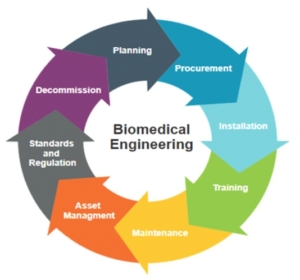
Clinical Engineers and Biomedical Engineers (BME) are the term given to Engineers working in the hospital sector related to medical device; the term depends on various countries. Their role starts from procurement, maintenance, safety and till decommissioning of medical equipment and their interaction is as shown in Figure – 1.
Figure–1 The role of Biomedical Engineer and the departments they interact [4]
Gas plant technician role in a hospital
Medical Gas plant located in the hospital is the department where medical gases such as compressed air, medical oxygen, nitrous oxide, carbon dioxide gases and vacuum system are available. The technicians associated to this plant involve in the management of the above gases where they help in storage, handling, distribution of medical gas cylinders. They monitor the oxygen level required for the smooth functioning of the hospital. Ordering the cylinders or liquid oxygen with the medical gas vendors, when they are low in volume and maintaining pressure of these gases without any pressure drop at all the outlets are part of their day-to-day activities. [5]
Brief explanation of Disaster and its consequences
The term ‘Disaster’ implies when there is an occurrence of a sudden event that disrupts a community or society, resulting in major losses that exceed its ability to cope with available resources. It can be natural or man-made, however as per UN`s International Strategy for Disaster Reduction (ISDR), it should have resulted in 10 or more mortalities or it affects 100 people or declaration of state of emergency or request for international assistance.[6]
Elements that tend to increase the severity of disaster are, Poverty and inequality, Deficiency in Healthcare system, Climatic change and environmental degradation, Lack of awareness and information, Political instability and conflicts, Inadequate disaster preparedness and poor infrastructure, Population growth and rapid urbanization. [7]
Table – 1 Categorization and Examples of Hazards leading to Disasters. [7]
| Sl.No. | Types of Hazards | Explanation | Examples |
| 1 | Natural | Due to geological or metrological effect | Cyclones, Earthquakes, Tsunamis |
| 2 | Man-induced | Due to negligence and mostly of technological development | As below |
| 2a | Physical | Due to explosions | Radiation |
| 2b | Chemical | when exposed to toxic chemicals | Industrial chemicals |
| 2c | Biological | when exposed to harmful living organisms | Virus |
| 2d | Behavioural | due to negligence in human behaviour | Road accidents |
Table 2: Number of Climatic disaster events (1995-2020) in South India. [8]
| State | Cyclone | Cold wave | Heat wave | Flood | Drought | Total |
| Karnataka | 1 | 7 | 23 | 17 | 11 | 59 |
| Madhya Pradesh | 2 | 26 | 25 | 12 | 4 | 69 |
| Rajasthan | Nil | 26 | 26 | 13 | 16 | 81 |
| Tamil Nadu | Nil | 8 | 19 | 10 | 5 | 42 |
| Uttar Pradesh | Nil | 26 | 26 | 18 | 7 | 77 |
Precautionary steps to be taken by BME and Gas plant for Disaster
- Utilization of equipment apart from his primary functions: Anesthesia workstation can also be utilized as ventilator during this emergency, wherein training for this has to be provided to the clinical users by either the in-house Clinical Engineer or the Application specialist from the respective manufacturer. This training can be done on-request basis or during the installation. Even the C-arm fluoroscopy can be utilized as Mobile X-ray.
- Maintaining database of local medical equipment rental providers: Fixing rate contract for rental of critical equipment such as ventilators and patient monitors can be done annually and the logistics to borne by the vendor. Sharing a good rapport with other vendors will be helpful as they might provide their available demo equipment also for our utilization
- Sourcing equipment from available sites: If there is a medical college inside the hospital premises, shifting of equipment from there can be done; e.g. Department of physiology and community medicine will be having Electrocardiography, BP apparatus as per National Medical Council, India norms [9] which can be utilized. This equipment are to be identified in prior and to be informed with the concerned department HODs and approval to be sought ahead explaining the procedure, so that during the disaster, quick and smooth transfer of equipment can be done without any delay in getting approval.
- Load calculation at the designated areas: Engineers should be aware of the power calculation and breaker rating for all the critical care area in a hospital. E.g.: at Emergency medicine department, allocation of power will be based upon the existing equipment (ventilator, monitors, mobile X-rays) which is used on day to day basis. Whereas when the count of the equipment utilization increases, there are chances of UPS or raw power getting overloaded. Discussion with Maintenance and Project department is to be done in deriving a solution for it.
- Standardization and Uniformity in the medical gas outlets: Various types of medical gas outlets (DIN, BS, BOC and many) are available. The key plugs differ for each type, so when a ventilator or a flow meter must be shifted from DIN to BIS, availability of gas plant technician to be sought and changing the key plug will be time consuming for gas plant technicians.
- Drafting of Standard Operating Procedure (SOP) and conducting mock drills: A SOP for the above methods has to be drafted and approved by the Medical Director and the training for the same has to be given to all the Clinical Engineers and a mock drill to be conducted yearly once. Documentation for the above has to be maintained in the department records.
During Disaster
- Efficiency in managing the available resources: If more number of B type cylinders are required at a specific ward, instead of mobilizing more than 10 no`s of B-type cylinders, 2 chained D-type cylinders can be connected to a port using regulators and by isolating the ward by closing the entry gas valve, the oxygen can be provided from D type cylinders to all the ports. However, frequent monitoring by gas plant personnel to be done at these places since changing the empty cylinder is needed. Secondly, with the help of dual connectors of flow meters, from a single outlet, two flow meters can be connected. Third, B type cylinders can be used for shifting purpose alone.
- Arranging for medical oxygen load to meet patient load: D-type cylinders for manifold and another load of liquid medical oxygen for the cryogenic vessel are to be ordered by the Manifold In-charge. This is because usually hospitals maintain a backup of two days oxygen capacity alone.
- Assigning roles to Biomedical Engineers and Manifold technicians: When the news regarding the situation has been informed, minimum two engineers are to be deputed to collect data of the unutilized critical care equipment which are not being connected to the patient in ICUs. Arrangements for shifting of this equipment are to be started immediately. Utilization of these resources is to be given priority. Similar process to be followed for available flow meters too. Engineers those who are on OFF duty or leave may be called to duty.
Post Disaster
- Returning the equipment in original condition: Equipment shifted from medical colleges, ICU, OT and from the rental vendors are to be returned in the original functioning condition so that they can be put into use for the patients.
- Cleaning and Decontamination of equipment: Equipment which have been utilized during the disaster, are to be cleaned and free of pathogens before they are being handed over to the ICUs or OT to reduce further infection.
- Review the entire event: Study pitfalls for improvement which would have been alarming, train the Engineers for reducing them, and update the SOP if needed.
Challenges expected during the Disaster
- Being vigilante in shifting critical care equipment: During the emergency, almost care for the equipment to be considered when entering and exiting the lifts, corridors or from one building to another; to avoid trembling of the internal circuit boards in ventilators, mobile x-ray, C-arm fluoroscopy, Ultrasound as replacing them are of high value and downtime during the disaster could not be manageable.
- Oxygen Pressure drop will occur due to more outlets utilization: Pressure drop might occur at the oxygen ports which might be the reason if the design in laying of pipelines is not calculated. The size of the header and the raiser in the Medical Gas Pipeline System especially for Oxygen must be high depending on the number of outlets drawn from it. Secondly, to maintain the pressure at all areas, the outlet pressure of the cryogenic vessel containing the medical oxygen is to be increased.
- Manpower requirements: More number of attenders and Engineers are needed for the shifting of equipment and cylinders to and from various places as cylinder distribution and transportation are to be done in quick basis as many may need B type cylinders for transportation to and from casualty to Radiological or other services.
- Safety and security of medical equipment: During the disaster, if there is mass casualty, damages to the equipment may occur due to some chaos and panic amongst the patient and their attenders, chances of accessories (ECG cable, Spo2 probe and NIBP cuff) getting stolen are high.
Summary
Handling precautionary measures for disaster management will aid in reducing the risks and the consequences involved during disaster thereby saving lives and reducing physical losses.[10] Clinical Engineers and Manifold technicians have the majority share next to the Doctors and Nurses during the disaster management. Being prepared for the same and maintaining a SOP followed by mock drills and training in tackling the scenario will be advantageous to the hospital staff and thereby many lives also can be saved.
Conflict of Interest: None
Source of Funding: This study did not receive any external funding.
Authors’ Contributions
SS: Manuscript writing, revising critically for important intellectual content. Author approved the final version to be submitted and to publish the article.
Here, SS: Shalini Shribalaji
References
- Zibulewsky J. Defining disaster: the emergency department perspective. Proc (Bayl Univ Med Cent). 2001 Apr;14(2):144-9. doi:1080/08998280.2001.11927751. PMID: 16369605; PMCID: PMC1291330.
- Joseph f. dyro, “Clinical engineering handbook” 2004, academic press, 27 August 2004, pages 2-3.
- “Storage, handling and transportation of medical gas cylinders – CHW”, 01 September 2023, The Children`s hospital – Westmead, procedure no: 2016-9044 v3
- WHO Medical device technical series, “Human resources for medical devices, the role of biomedical engineers”, 31 August 2022, ISBN:
- DH Estates and Facilities Division, Medical Gases, “Health Technical Memorandum 02-01: Medical gas pipeline systems”, Part B: Operational Management, May 2006.
- Khorram-manesh amir, “Handbook of disaster and emergency management” first edition, 10 October 2017, pages17-18.
- SaimaAkbar, Suraj Kumar Singh, Shruti Kanga, “Disaster Management: Preparedness and Mitigation”, 1 October 2024, pages 7-8.
- NMC ref – National Medical Commission, “Undergraduate Education Board” Notification dated: 16th August 2023.
- A.K., Chopde, S., Nair, S.S., Singh, S., and Bindal, S. (2021). Mapping Climatic and Biological Disasters in India: Study of Spatial & Temporal Patterns and Lessons for Strengthening Resilence. Deutsche Gesellchaft fur Internationale Zusammenarbeit (GIZ) GmbH India. Page: 140.
- Suparji Suparji et al. “Disaster preparedness culture in Japan and Indonesia: cultural perspectives and practical implementation (a commentary)”. PAMJ-One Health. 10 September 2024.
 This is an open access journal, and articles are distributed under the terms of the Creative Commons Attribution‑Non-Commercial‑ShareAlike 4.0 International License, which allows others to remix, tweak, and build upon the work non‑commercially, as long as appropriate credit is given, and the new creations are licensed under the identical terms.
Abstract Full-Text PDF

